
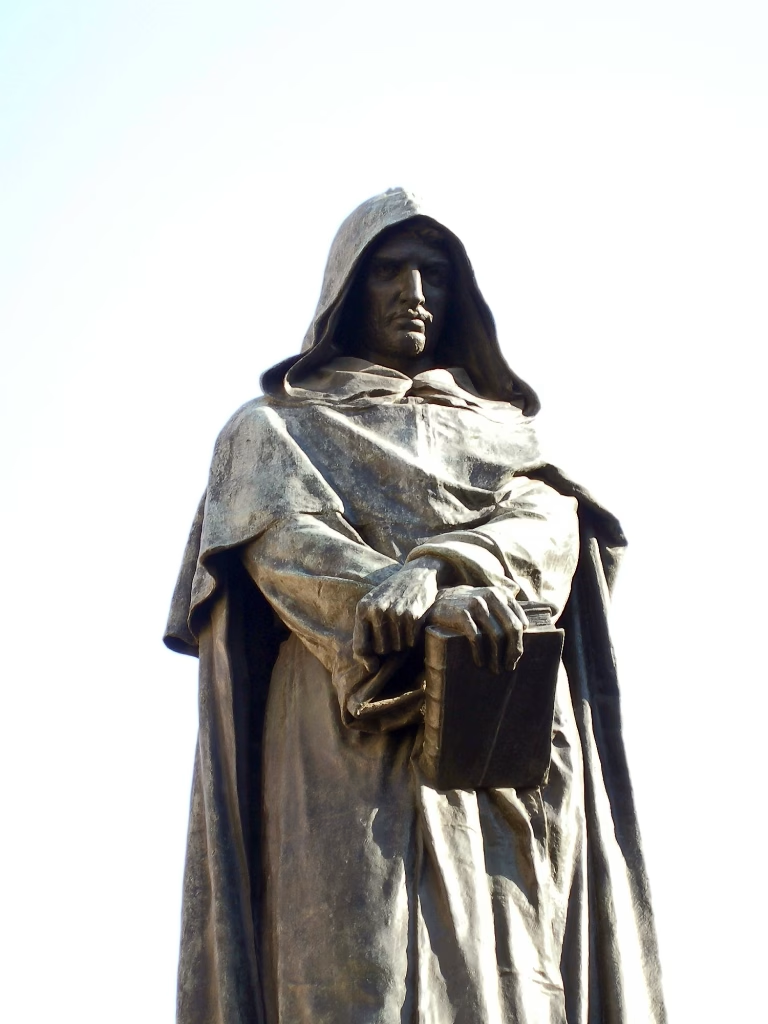
Giordano Bruno. The Man and the Myths, a Google researched article for my current work in progress: “A Death in the Dolomites”. It started off as a basic murder mystery before expanding into something a little more complex.
Giordano Bruno Overview
Giordano Bruno (1548–1600) blended geometry, metaphysics, and Hermetic magic into a single system, arguing that mathematical figures were not just abstract tools, but symbols holding the hidden structure of an infinite universe. [1, 2, 3]
1. Mathematics & “Atomistic” Geometry
Bruno rejected traditional Euclidean geometry, which treated lines and shapes as infinitely divisible. Instead, he proposed a physical, discrete geometry in works like Articuli adversus mathematicos (Articles Against the Mathematicians, 1588): [1]
The Geometric Minimum. Bruno argued that every line, plane, and solid is built from indivisible, physical building blocks (similar to atoms). [1]
Critique of Measurement. He believed contemporary astronomers and mathematicians relied too heavily on abstract calculations that ignored the living, physical reality of the cosmos. [1, 2]
2. Geometric Seals & The Art of Memory
Bruno was famous across Europe for his mastery of ars memoriae (the art of memory), which he turned into an occult practice: [1, 2]
Magical Diagrams. He engraved complex geometric woodcuts—known as sigilli (“seals”)—combining intersecting circles, triangles, and stars. [1, 2, 3]
Mental Talismans. Bruno taught that meditating on these geometric archetypes (such as the figures of Mind, Intellect, and Love) aligned the human mind with the divine structure of the universe, allowing a person to retain vast amounts of knowledge and channel cosmic forces. [1, 2, 3]
3. Metaphysics & Hermetic Magic
In treatises like De Magia (On Magic) and De Vinculis in Genere (On Bonding in General), Bruno treated magic as a natural science of hidden connections: [1, 2, 3]
An Infinite, Living Universe. Building on Nicolaus Copernicus, Bruno argued that the universe has no center, that stars are distant suns with their own inhabited worlds, and that all matter is animated by a single divine spirit (pantheism).
Magical “Bonds” (Vincula). He divided magic into Divine, Mathematical, and Physical branches. For Bruno, a magician operates by understanding the invisible psychological, emotional, and physical “bonds” connecting all things in nature. [1, 2, 3, 4]
4. Downfall and Execution
Bruno’s radical ideas made him unwelcome across Europe—he was excommunicated by Catholics, Calvinists, and Lutherans alike. In 1591, a Venetian nobleman named Giovanni Mocenigo invited Bruno to teach him memory magic, then denounced him to the Inquisition when he felt cheated. After an eight-year trial in Rome, Bruno refused to recant his beliefs on the infinite universe, reincarnation, and Catholic doctrine, and was burned at the stake in Rome’s Campo de’ Fiori on February 17, 1600. [1, 2]
For deeper reading, explore the Internet Encyclopedia of Philosophy entry on Giordano Bruno or his translated essays in Giordano Bruno: Cause, Principle and Unity and Essays on Magic. [1, 2]
***
Seals and Wheels
Giordano Bruno’s geometric seals and memory wheels were visual, mental “machines” designed to organize all human knowledge, encode words into vivid imagery, and align the human mind with the hidden geometry of the cosmos.
Inspired by the medieval philosopher Ramon Llull, Bruno built concentric rotating rings in De Umbris Idearum (On the Shadows of Ideas) that functioned like a mental combination lock: [1, 2]
The 30-Letter Alphabet.
Bruno divided his wheels into 30 segments using a trilingual alphabet: 23 Latin letters, 4 Greek letters, and 3 Hebrew letters. [1, 2]
Concentric Rings of Images.
Each ring corresponded to a different category—such as mythological figures (agentes), actions (actiones), attributes (insignia), and objects (circumstantia). [1]
How It Worked. By mentally “rotating” the rings to align specific letters, a practitioner generated a vivid, surreal scene (for example, a specific mythological figure performing a specific action with a specific object). This encoded abstract words, syllables, or concepts into unforgettable mental pictures that could be stored inside a traditional “memory palace”. [1, 2, 3]
Cosmic Mirror.
Beyond practical memorization, Bruno saw these 150-rayed wheels—filled with zodiacal and planetary symbols—as a miniature map of the universe. Internalizing the wheel meant holding a reflection of cosmic order inside one’s own mind. [1, 2, 3]
***
In works like Triginta Sigilli (Thirty Seals) and Articuli adversus mathematicos, Bruno carved intricate woodcut diagrams (sigilli) built from intersecting circles, triangles, squares, and stars: [1, 2]
Mental Data Structures. Many of the “Thirty Seals” were structural blueprints for organizing memory palaces. For example, The Field worked like a coordinate grid for placing mental images, The Sky mapped memories onto astronomical constellations, and The Tree arranged main ideas along a trunk with subsidiary details on branches. [1]
Archetypal Meditation. Other woodcuts—such as Figura Mentis (Figure of Mind), Figura Intellectus (Figure of Intellect), and Figura Amoris (Figure of Love)—served as contemplative mandalas. Bruno believed that meditating on these pure geometric archetypes bypassed ordinary sensory confusion, allowing the soul to ascend toward divine truth and channel natural magic.
To explore these reconstructions further, visit the Warburg Institute’s archive on Bruno’s mnemonics or read the overview on Wikipedia’s Memory wheels.
***
Secrets
The story of the “stolen” book of secrets stems from the dramatic 1592 betrayal of Giordano Bruno by his wealthy Venetian patron, Giovanni Mocenigo—an incident that blends documented historical paranoia with centuries of esoteric rumor.
1. The Historical Core: A Patron Expecting Magic
In 1591, Mocenigo read Bruno’s cryptic treatises on memory and geometry and invited him to his Venetian palace (Ca’ Mocenigo), promising protection and payment in exchange for private lessons in “the secret of memory and other things that he knew”. [1, 2]
The Disappointment. Mocenigo expected a shortcut to supernatural power, effortless genius, and occult influence. Instead, Bruno tried to teach him rigorous logic, geometry, and exhausting visualization exercises. [1, 2]
The Suspicion. Frustrated by his own lack of progress, Mocenigo grew convinced that Bruno was deliberately withholding the true “key” to his system—and intended to take that secret to rival patrons in Frankfurt. [1, 2]
2. The Attic Trap and Confiscated Manuscripts
In May 1592, when Bruno packed his bags to return to Germany to publish new manuscripts, Mocenigo snapped: [1, 2]
The Kidnapping. On the night of May 21, Mocenigo burst into Bruno’s bedroom with several armed servants, locked the philosopher in an attic storeroom, and confiscated all of his personal papers, books, and unpublished manuscripts.
The Denunciation. Two days later, Mocenigo handed Bruno—along with his seized manuscripts and a list of heretical statements—over to the Venetian Inquisition, claiming he was acting out of Christian conscience. During his trial, Bruno testified that Mocenigo had actually imprisoned and denounced him out of spite because he refused to hand over all his philosophical and mnemonic secrets. [1, 2]
3. The Esoteric Legend: What Was Supposedly Inside?
Because Bruno’s private manuscripts disappeared into the archives of the Inquisition (and several were not rediscovered until the 19th century in Russia, known as the Noroff Manuscripts), occultists and historians speculated for centuries about what Mocenigo had seized: [1]
The Master Key to the Seals. Legend held that Bruno possessed an unpublished “master cipher” that unlocked the magical power of his Thirty Seals and memory wheels, allowing a practitioner to instantly absorb all sciences without study.
The Art of Psychological Control (De Vinculis in Genere). One of the unpublished texts Bruno was working on right before his arrest was De Vinculis in Genere (On Bonding in General). Unlike his earlier books on geometry, this unfinished treatise was a manual on how a “magician” (or ruler) can manipulate human emotions, desire (Eros), and imagination to bind and control the minds of individuals or entire crowds. Esoteric lore transformed this psychological treatise into a legendary “grimoire of mind control” that Mocenigo tried to steal for political power in Venice. [1, 2, 3]
You can read the surviving Latin text and English translation of the confiscated treatise in the Esoteric Archives’ edition of De Vinculis in Genere, or explore the historical context in the Stanford Encyclopedia of Philosophy. [1, 2]
Would you like to look closer at the ideas inside De Vinculis in Genere (Bruno’s manual on psychological manipulation and “bonding”), or explore how the lost Noroff Manuscripts were eventually rediscovered?
The Dolomite connection.
The Mocenigo Family’s Historical Ties to the Dolomites:
Giovanni Mocenigo, the Venetian nobleman who imprisoned Bruno and confiscated his manuscripts, belonged to one of Venice’s most powerful patrician dynasties. A century earlier, Doge Tommaso Mocenigo forged the 1420 pact bringing Cadore (the heart of the Belluno Dolomites) under Venetian rule, and the Mocenigo family maintained estates and political ties across the Veneto mainland extending toward the foothills of the Dolomites. [1]
The “Giordanisti” & Alpine Crossing:
When Bruno fled Italy in 1576 and later returned in 1591 from Frankfurt to Venice, his routes crossed the Alpine passes (such as the Brenner Pass through Tyrol/South Tyrol, right on the edge of the Dolomites). In esoteric lore about the Giordanisti (his supposed secret brotherhood), Alpine trade routes were the conduits through which banned Hermetic books moved between Germany and Venice.