
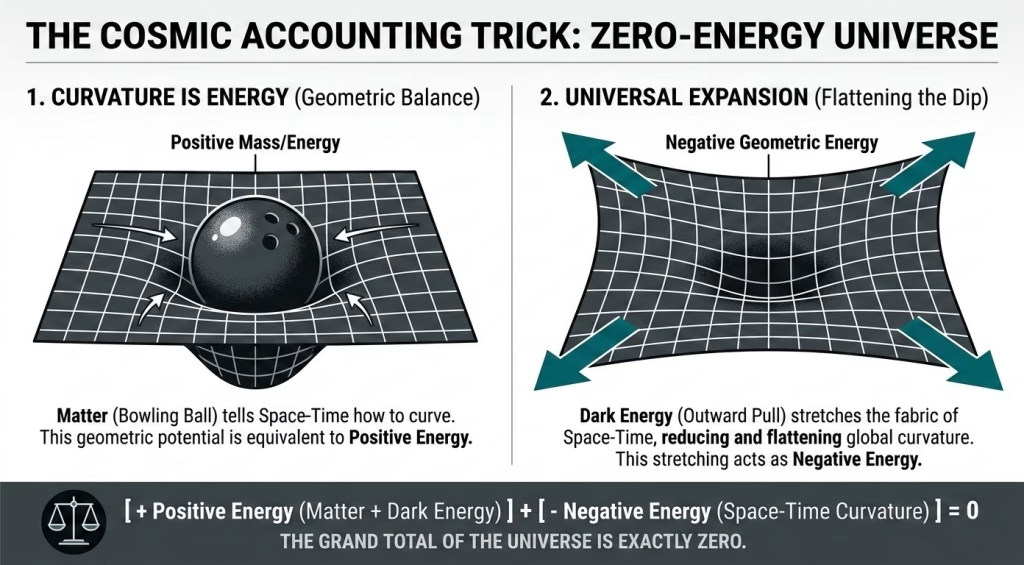
General Relativity. Gravity is not a physical “pulling force” like magnetism; it is a geometric consequence of matter bending the fabric of space-time.
However, even when viewed through this geometric lens, the energy balance of the universe still holds true. Here is how physicists translate the concept of “gravitational energy” into the bending of space-time to explain where dark energy gets its fuel.
1. Curvature is Energy (The Geometric Balance)
In General Relativity, mass, energy, and the curvature of space-time are fundamentally locked together. Einstein’s famous field equations can be summarized simply as: [8]
$$\text{Matter and Energy Tells Space How to Curve } \longleftrightarrow \text{ Space Tells Matter How to Move}$$
Because space-time is a dynamic, flexible fabric, bending it requires work, and stretching it stores potential. When dark energy causes the universe to expand, it changes the overall shape and curvature of the universe.
In physics, changes in space-time curvature are mathematically equivalent to changes in gravitational potential energy. So, while “gravity” is a model describing bent space-time, that bending itself carries a mathematical value that perfectly balances out the creation of dark energy.
2. The Universal Accounting Trick
To see how this works without using the old-fashioned idea of a gravitational “pulling force,” think of the universe as a flat trampoline:
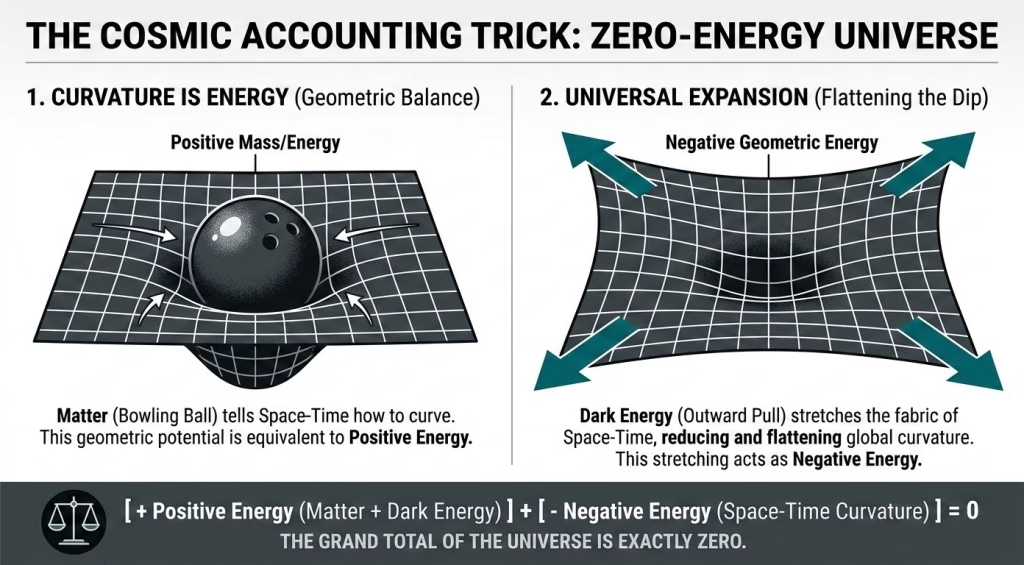
- Creating a Dip: If you place a heavy bowling ball (matter) on a trampoline, it creates a deep dip. To create that dip, energy had to be used to stretch the fabric downward.
- Flattening the Dip: If you pull the edges of the trampoline outward to expand it, you are changing the shape of that dip.
As dark energy stretches the universe, galaxies are moved further apart, changing the geometry of space-time around them. This geometric rearrangement acts exactly like a cosmic savings account. The “debt” is stored in the altered geometry of space-time, which perfectly offsets the new dark energy filling the newly created space.
3. The Ultimate Net-Zero Universe
Because of this precise geometric balance, many cosmologists—including the late Stephen Hawking—put forward the Zero-Energy Universe hypothesis.
If you add up all the positive energy in the universe (the mass of stars, dark matter, and the growing amount of dark energy) and subtract the total geometric “debt” stored in the curvature of space-time, the grand total of the universe is exactly zero.
[ + Positive Energy (Dark Energy + Matter) ] + [ – Negative Energy (Space-Time Curvature) ] = 0
The universe doesn’t need to steal energy from an outside source to expand, nor does it violate any laws of physics. It is simply dividing “nothing” into two equal and opposite parts: more flat empty space (positive dark energy) and a different global space-time structure (negative geometric energy).
Key Takeaways
- Gravity is a geometric consequence of matter distorting space-time, rather than a pulling force.
- In General Relativity, mass, energy, and space-time curvature are interconnected, demonstrating that changes in curvature represent gravitational energy.
- As dark energy expands the universe, it alters space-time geometry, akin to stretching a trampoline, with energy stored in that geometric change.
- The Zero-Energy Universe hypothesis suggests the universe’s total energy balances out to zero, combining positive energy and negative geometric energy.
- The universe expands without external energy, creating a balance of positive dark energy and negative curvature in space-time.
Previous: The Expansion Related More on Dark Matter