

Image attribution : Jay Dixit / WikiPortraits
Sydney Sweeney, Zendaya, Hunter Schafer, and Billie Eilish. An Anarchist Perspective.
To understand how classical anarchist thinkers like Peter Kropotkin, Emma Goldman, and Mikhail Bakunin would analyze Sydney Sweeney, Zendaya, Hunter Schafer, and Billie Eilish, we must look past modern cultural labels. From a 19th- and early 20th-century anarchist perspective, the distinction between “conservative traditionalism” and “progressive inclusion” is largely a surface-level illusion.
Anarchists would view all four women not as independent cultural icons, but as highly sophisticated commodities manufactured by the capitalist state to reinforce the status quo, pacify the working class, and commodify human identity.
1. The Global Anarchist Critique: The Spectacle of the “Radical” Celebrity
Kropotkin and his contemporaries would begin with a unified premise: True liberation cannot be bought, sold, or broadcast under a capitalist hierarchy.
They would argue that the capitalist market possesses an insatiable ability to absorb its own critiques. By taking radical ideas—such as racial equality, trans liberation, and environmentalism—and turning them into highly profitable celebrity brands, capitalism successfully neutralizes their revolutionary potential. The working class is tricked into believing progress is being made because they see diverse faces on billboards, while the underlying economic structures of exploitation remain entirely unchanged.
2. Individual Profiles: The Anarchist Analysis

Sydney Sweeney: The Hyper-Individualist Bourgeois Illusion
- The Critique of Her Image: Emma Goldman, a fierce pioneer of anarcho-feminism, would view Sydney Sweeney’s brand with deep skepticism. Goldman argued that true female emancipation requires a woman to think and act as a free individual, entirely rejecting the idea of herself as a sexual commodity for male ownership. Sweeney’s commercial reliance on the traditional male gaze and her “bootstrap individualism” would be diagnosed as a regression.
- Capitalist Function: Peter Kropotkin would analyze her American Eagle “genes” campaign as a textbook example of capitalist division. By allowing her image to be co-opted by right-wing nationalists, the market uses her to stoke tribal, cultural warfare among the working class. This distracts workers from their shared economic exploitation, pitting them against one another over “traditional values” versus “wokeism” while billionaires pocket the profits from both sides.
Zendaya: The Capitalist Co-optation of Structural Reform
- The Critique of Her Image: Mikhail Bakunin, who argued that any participation in or reform of hierarchical institutions merely legitimizes them, would focus heavily on Zendaya. Zendaya represents “institutional progress”—using corporate media power to elevate marginalized creators. Bakunin would argue that “diversifying the ruling class” does not liberate the oppressed; it merely changes the color of the oppressor’s hand.
- Capitalist Function: Kropotkin would see Zendaya’s high-fashion campaigns (Louis Vuitton, Lancôme) as the ultimate pacification tool. Capitalism takes the righteous fury of Black liberation movements and distills it into an elite, expensive lifestyle brand. The message sent to the masses is that racial equality looks like a wealthy elite wearing luxury goods. It neutralizes the desire for a horizontal, classless society by making capitalist success the ultimate goal of racial progress.
Hunter Schafer: The Commodification of Lived Identity
- The Critique of Her Image: Anarcho-feminists would recognize Schafer’s raw, experiential trans visibility as deeply human, but would mourn how it is processed by the market. Early anarchists fought bitterly against the state’s right to categorize, police, and institutionalize human bodies and sexualities.
- Capitalist Function: They would argue that the market has turned Schafer’s radical gender fluidity into a high-concept luxury aesthetic for brands like Mugler. In an anarchist view, capitalism thrives on creating new markets. By corporate-packaging queer and trans identity, the system opens up an entirely new demographic of consumers. Dissent against the rigid binary is transformed into a niche, luxury market, ensuring that trans youth express their identity through consumption (buying the clothes, buying the makeup) rather than through revolutionary solidarity against the state.
Billie Eilish: The Co-optation of Eco-Dissent and Body Autonomy
- The Critique of Her Image: Kropotkin, who wrote extensively in The Conquest of Bread about humanity living in harmony with nature, would look closely at Eilish’s eco-progressive and anti-objectification stance. He would admire her initial refusal to let corporations sexualize her body. However, he would argue that her subsequent assimilation into mainstream corporate marketing proves the inescapable gravity of capitalism.
- Capitalist Function: Eilish’s green capitalism (eco-friendly tours, sustainable Gucci partnerships) would be heavily criticized. Anarchists argue that capitalism is inherently ecocidal due to its need for infinite growth. By marketing “sustainable luxury,” Eilish’s brand helps manufacture the dangerous illusion of the “ethical consumer.” It convinces the working class that climate change can be solved by buying the right corporate products, actively obscuring the anarchist reality: that saving the planet requires the total destruction of the capitalist mode of production.
Summary: The Matrix of Passive Representation
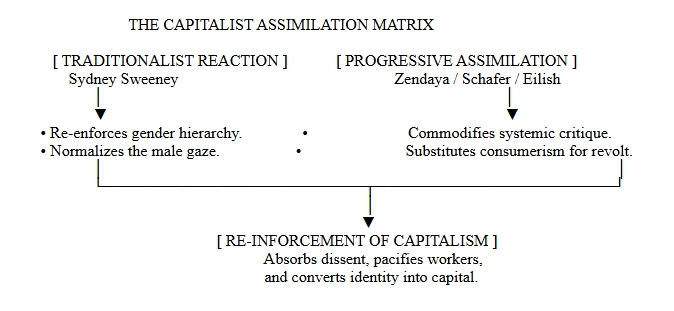
From the perspective of classical anarchism, these four icons are two sides of the exact same coin.
Whether the market exploits Sweeney’s compliance with traditional hierarchies or her peers’ subversion of them, the end result is identical. The capitalist market weaponizes their images to turn human struggles—for survival, identity, dignity, and expression – into passive entertainment and consumer options, successfully preventing the working class from uniting to overthrow the systems that cage them.