Dark Energy and the Expansion of the Universe
Dark energy density has remained completely constant, while the universe simply expanded around it.
In the early universe, matter and dark matter dominated because everything was packed tightly together. As space expanded, matter became diluted, allowing the unchanging density of dark energy to eventually take over.
The “Dilution” Illusion: Why Dark Energy Became Dominant
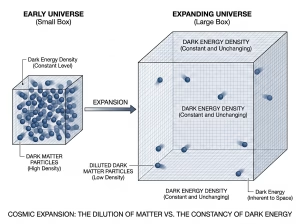

To understand why dark energy dominates today without actually multiplying, it helps to understand how the density of different components changes as space expands:
Matter and Dark Matter Dilute: Matter is made of particles. As the volume of the universe increases, the same number of particles spreads out over a larger space. Their density drops dramatically.
Dark Energy Stays Constant: Dark energy is an inherent property of space itself (often called the Cosmological Constant). Every cubic centimetre of empty space contains the exact same, tiny amount of dark energy.
The Box Analogy
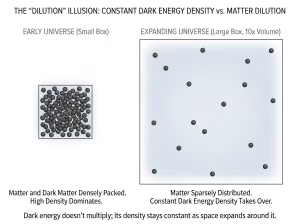

Imagine a sealed box containing three particles of dark matter and a set amount of space energy:
Early Universe (Small Box): The particles are crammed together. The density of dark matter is extremely high, completely overwhelming the faint background energy of the space.
Expanding Universe (Large Box): The box stretches to 10 times its size. The three dark matter particles are now far apart, so their density drops by 90%. However, the energy per cubic centimetre of the space itself remains exactly the same.
Because dark energy does not dilute, it inevitably overtakes matter as the universe grows larger.
The Cosmic Shift: From Deceleration to Acceleration
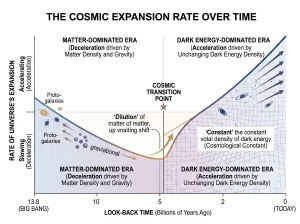

For the first few billion years, the high density of dark matter acted as a gravitational brake, slowing down the expansion of the universe.
The Cosmic Transition: Around 5 billion years ago, the universe expanded to a critical volume where the diluted density of matter fell below the constant density of dark energy.
The Cosmic Turnaround: At this exact point, the universe stopped slowing down and began accelerating outward, driven by the repulsive push of dark energy.
Where Did It Originate?
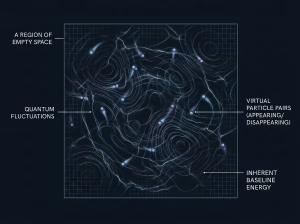

While its exact mechanism is still one of physics’ greatest mysteries, the leading theory from Albert Einstein’s General Relativity indicates that dark energy is the vacuum energy of space.
The Energy of Nothing: In quantum mechanics, “empty” space is never truly empty. It is filled with temporary quantum particles that constantly pop into and out of existence, creating a baseline energy.
Constant Creation: As the universe expands and creates new empty space, it inherently creates the vacuum energy that goes with it.
Therefore, dark energy didn’t multiply from a single point; it is built into the very fabric of space, waiting for the universe to grow large enough for its effects to be felt.