Are Supermassive Black Holes found in the Early Universe ‘failed’ Collapsed New Universes?
I asked this of Google Gemini and got this reponse.
The James Webb Space Telescope has recently discovered supermassive black holes (SMBHs) existing just a few hundred million years after our Big Bang. According to standard models of stellar evolution, there simply hasn’t been enough time for these black holes to grow so large by slowly eating matter. They would have needed to start as incredibly massive “seeds.”
The eternal inflation model provides a fascinating mechanism for how these massive seeds could have formed, and it looks very much like the “collapsed bubble” concept you described.
Here is how theoretical physicists currently model this interaction:
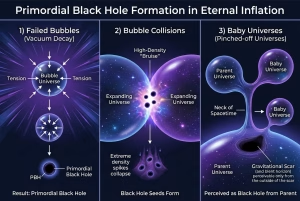
1. The “Failed” Bubbles (Vacuum Decay)
In eternal inflation, space is expanding violently, and quantum fluctuations constantly spawn new universe bubbles. Most of these bubbles have a positive vacuum energy and expand eternally.
However, quantum mechanics dictates that bubbles with a different or negative vacuum energy can also nucleate within our inflating region.
● Because their internal energy state is different, the “walls” of these bubbles have immense tension.
● Instead of expanding to become their own vast universes, the tension causes them to rapidly contract and collapse in on themselves shortly after forming.
● From the perspective of an observer in our universe, the immense mass-energy of that collapsed spacetime pocket is left behind as a Primordial Black Hole (PBH).
2. Bubble Collisions
Alternatively, our universe bubble could have physically bumped into a neighboring universe bubble while both were expanding in the primordial vacuum.
● The boundary where these two distinct universes crash into each other would experience a massive concentration of energy.
● This cosmic “bruise” would create extreme density spikes in our early universe. As our universe cooled, those specific ultra-dense regions would immediately collapse into black holes, bypassing the need for a star to ever exist.
3. Baby Universes that Look Like Black Holes
There is an even wilder mathematical outcome proposed by physicists like Alexander Vilenkin. Sometimes, a bubble nucleates and expands successfully on the inside, creating its own infinite space. However, due to the extreme warping of spacetime at its boundary, it pinches off from our universe. To anyone inside our universe looking at the “scar” left behind, it exerts intense gravity and has an event horizon. We would perceive it simply as a black hole, while internally, it is a fully expanding universe.
The Verdict on the Early Universe
Standard black holes are the tombstones of dead stars. But the supermassive black holes we see right at the dawn of time could very well be the structural remnants of eternal inflation—either failed bubbles that collapsed, collision points with other universes, or quantum fluctuations that birthed primordial mass.
If this theory holds true, those early supermassive black holes aren’t just cosmic vacuum cleaners; they are literal fossils of the multiverse.